Vigilant Awareness
The Curlew’s upright stance and watchful eye echo Sumatinatha’s teaching of jagriti — uninterrupted spiritual wakefulness, the antidote to the sleepwalking life.

Every emblem, every posture, every colour upon the Lord — a quiet language of liberation, written in the visual alphabet of the sacred.
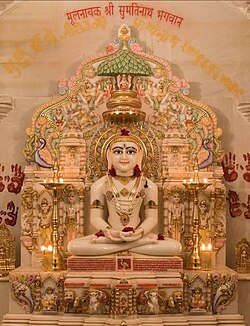
Every Tirthankara is identified by a distinct emblem — the lanchhan — carved or painted at the base of the idol. For Sumatinatha Bhagwan, this emblem is traditionally a Curlew (in some traditions, a Goose-like bird, the Krauncha) — a graceful, contemplative water-bird known for its piercing call and its quiet vigilance.
The choice is not incidental. The Curlew, with its long, listening posture and its delicate composure, becomes a perfect figurative companion for the Lord of Right Wisdom — a soul whose teaching is a sustained act of listening to the deepest layers of the self.
The Jain visual tradition is profoundly economical. A single emblem may carry an entire philosophy. Here is how the Curlew speaks for the Lord.
The Curlew’s upright stance and watchful eye echo Sumatinatha’s teaching of jagriti — uninterrupted spiritual wakefulness, the antidote to the sleepwalking life.
The Curlew is renowned for its piercing, plaintive call. Likewise the Tirthankara’s teaching pierces the noise of ordinary life — a single syllable of truth carried over vast distances of confusion.
Found at the meeting of land and water, the Curlew symbolises the seeker poised between two worlds — the worldly and the eternal — without losing footing in either.
Sumatinatha Bhagwan is traditionally worshipped in either of two timeless postures of liberation. In Padmasana (the lotus seat), he is seated cross-legged in deep meditation, hands open in his lap, eyes turned inward — the very image of an awakened soul at rest within itself.
In Kayotsarga (the standing posture), he stands erect, arms hanging without contact, body abandoned as a vehicle of self — a pose so still that, the texts say, even the wind chooses to pass quietly.
Both postures share a single message: the soul’s sovereignty does not depend on motion. Stillness is itself the most powerful act.
The temple sanctum is a visual scripture. Each tone, each motif is a doorway.
The traditional varna (complexion) of Sumatinatha Bhagwan’s idol is golden — the colour of awakened intelligence, of dawn, of unshakeable inner clarity.
The Ashta Mangala — eight auspicious symbols including the swastika, srivatsa, mirror, and full vase — frame the Lord, marking the temple as a sacred geometry of wholeness.
A circular aureole behind the head, denoting the boundless light of Keval Gyan. Its concentric rings remind the devotee that infinity radiates outward from a single, awakened point.
The Lord is seated upon a lion throne — for the lion is the king of the forest of senses. Only one who has tamed that king sits with such complete poise.
A three-tiered canopy floats above the Lord, marking sovereignty across the three worlds — earth, the celestial realm, and the realm of the liberated.
The Priyangu tree, beneath whose branches Sumatinatha Bhagwan attained omniscience, is often depicted behind the idol — a quiet reminder that the path runs through the simple shade of patience.

Walk into the sacred geography of his royal birth.